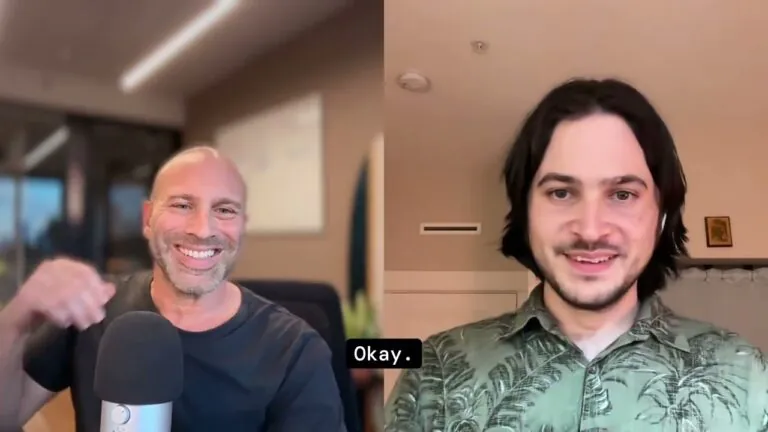
Auto-generated transcript, lightly edited for readability. Speaker labels are assigned automatically and timestamps follow the video.
00:01Oren Toledano, Swimm CEO
Today I'm joined by Motti Finkelstein, former CIO at Intel and former CTO at BMO Capital Markets, and also a former CTO at Citi. Motti has been on the other side of the table when big technology decisions get made. So today we're talking about what actually gets a modernization project approved, what keeps it alive, and where AI can help. Motti, great to have you here.
00:28Motti Finkelstein
Good to be here.
00:29Oren Toledano, Swimm CEO
Alright, let's dive in with some, you know, something practical. You're you're a bank CIO and another yet another modernization proposal lands on your desk. So usually who initiates this type of projects and what do you look at first?
00:48Motti Finkelstein
Y y you'd be shocked. Initiating projects come from all over the place. initiating the knowledge of you can do this project comes from all over the place. so let's talk about possibilities. Possibilities are there is a business need. And there is a business need and then the business and technology looks for solutions. And
whether they have relationships with existing vendors, with existing partners, or with they have to look for new solutions, you know, through newer companies and so on, the they'll search for it. But also various times you'll have companies that you know have relationships let's say with VCs in many cases you also have
01:37Oren Toledano, Swimm CEO
Yeah.
01:41Motti Finkelstein
Board members that have seen various things. you have business owners and technologists that in conferences have seen various solutions that they associate with solving a problem that exists for the business. And when I say business, you have to think of what I call the broader business. What is a business in my book? It's either business that a company provides externally.
or its own internal business that they're solving a problem for because it costs them too much, it's too complicated. So IT is a business on its own, while IT as a business usually partners with other business units in the company to provide solutions and products externally.
02:18Oren Toledano, Swimm CEO
Mm-hmm.
It's usually like a joint decision to get to decide whether a project gets approved or it's more in the CIO agency to to make these type of decisions.
02:45Motti Finkelstein
I I would say that more and more it's much more of a joint decision. also budgets are complex and so how does it get funded? Where is the benefit? and now in many cases the benefit is in the business unit itself. So the funding is expected to be there potentially, or to be charged back or to be showed.
in a way that you can correlate the benefit to the expense.
03:20Oren Toledano, Swimm CEO
Is there usually the budget comes only from the business units or there is also a corporate budget that you know when there is a a wide enterprise decision that is involved or it's expected from the business units to together to fund the project?
03:38Motti Finkelstein
So it's mixed. So it depends on is this for everyone? Is this for the benefit of the company as a whole? Usually that's in the IT budget and the corporate budget. is this an investment budget? That's usually in the IT budget. But if this is for a specific business, many times it will be in the specific business budget paying for it, either directly or indirectly.
And it also depends on the size of the company, it depends on how the business units work together. so there's no one answer that fits all.
04:18Oren Toledano, Swimm CEO
All right, so the the proposal gets your attention and you say let's look at it, let's do this. How far are we from this point to an actual yes? What is the process there?
04:30Motti Finkelstein
First of all, why does it get my attention?
04:33Oren Toledano, Swimm CEO
I mean it gets to the CIO table, and what what kind of questions are you asking you know in order to make a decision, in order to to push it forward?
04:45Motti Finkelstein
So so several questions I'd ask first, right? Is this solving a real problem that I have that's on my priority list of problems to solve? Is this solving a business problem, either an IT business problem or an external corporate business problem or a specific business unit problem? Because I'd have to understand how important it is, how costly it is.
how long it would take to solve. You know, when I was a at Citi, there was a point of time when I got the POC lab. The lab at Citi was very large.
mil tens of millions of dollars of of lab equipment. a lot of the POCs were there for one, two, three years. no end of sight. It's really not sustainable for many companies to deal with, you know, let's say Citi if you're gonna be in POC for three years. but but the rule we implemented at the time was you have to get an answer, yes or no.
05:37Oren Toledano, Swimm CEO
Mm. Wow.
05:57Motti Finkelstein
three months. What's the cost of success?
What are you trying to achieve? What's the benefit of this of doing this? What's the cost of doing this? What does it take the timeline to implement? You have to have some real basic questions. So when I see a proposal, I want to see some real answers. What products go away if I implement this? What gets simplified? What revenue gets generated or time to market improves? What savings does it enable?
06:17Oren Toledano, Swimm CEO
Right.
06:32Motti Finkelstein
What are the business answers to that this technology brings to play? You know, one of the problems, to be perfectly honest, when startups come to CIOs is they they the first thing they they they say is, we're not instead of anything. we're just an an add on to I go, okay, so where do you expect me to pay you from? You're just an an additive item.
07:00Oren Toledano, Swimm CEO
So interesting. So on on the startup side, we there is a a a big discussion about what we call the champion, right? The person within the corporate that is going to be your counterpart and and move this deal and you know be your sponsor maybe for maybe this internal discussions. On the CIO side, how does it look like? Do you want direct communication with the vendor? You expect all this
questions to be asked to an internal champion. could you could you tell us for and what is the right level for such a champion? Is there a any importance in the the the champion title or whatever it is? How do you look at this internally?
07:48Motti Finkelstein
So so it depends, 'cause champion is a very broad term. so it depends on the champion, depends what the champion is doing. Depends what the champion is championing. You know, if the champion is is telling me, this is such cool technology, you know, that's interesting. It interests me just because I love technology, but as a CIO, what business problem does it solve?
If they're gonna tell me it's cool technology and it's gonna prevent outages and it's gonna save me money and it's like really eliminates other products I have, now you have my attention. so it really depends, you know what the person is championing. It also depends on is the person the right person to really
go around the various I'll say functions and entities that are needed in order to get something new brought in. And and what does that mean? many companies created processes to help with this because it is complex. But you have to get you know security to review a product. You have to get the business to review the benefits.
09:00Oren Toledano, Swimm CEO
Right.
09:18Motti Finkelstein
To stand by the benefit that if the product delivers, if the solution comes to fruition, you really actually achieve something and the business gains something. You also have to understand the timeline take.
You also want to correlate the cost of something and see the benefit alongside it. So many companies want to charge you X up front, but you don't use X up front. You use X minus Y upfront.
I need to correlate my expense, either my own IT expense or the expenses that I pass on to other business units. I need to ensure the safety, privacy, security of what I implement, you know, for the benefit of the entire corporation. I need to make sure that I know what comes out if something comes out and when.
and how I achieve it. And I need to understand if this is one of the business's priorities to achieve, because they're looking to achieve this benefit. And I'll tell you an interesting story. I was when I was at Citi, this this was great, I get a quote from one of the the guys, one of the team members, and saying, Well this business unit wants us to spend
fifteen million dollars to buy this equipment because it's gonna make them a billion and a half dollars. I said that's fantastic. That's great. I called the managing director of that business unit. I said you should be congratulated, you know, I'm actually gonna put a big post on the on the website, the internal website, you know, saying what a great job your team is doing.
goes, I'll spend the fifteen million dollars, but I'm gonna publish that. You're gonna commit to one point five billion dollars of, you know, revenue because of that. And and I think it's a great partnership. We should definitely do that. And he goes, What? What are you talking about? I said, that's what your team came to my team and and asked. They asked me to spend fifteen million dollars, buy this great stuff.
11:29Oren Toledano, Swimm CEO
Mm-hmm.
11:46Motti Finkelstein
And you know, we'll do the security review, we'll go through the process. I think it's fantastic. If you generate a billion and a half, you you should be commended. So let's advertise it. He goes, hold on, let me go check this out. I got a call thirty minutes later saying, Don't buy anything. I don't even know if it's gonna r generate as much as it costs.
11:59Oren Toledano, Swimm CEO
Okay.
Mm-hmm. Yeah, I understand. So that's interesting because my my next question was about money. And in a previous discussion with me, you've used the phrase it needs to be expensive but not too expensive, right? And my question was to be how do you you find that number? I think you've started answering it by connecting the business impact.
12:15Motti Finkelstein
Yeah.
Expensive is not a expensive is not a number. You know, we think of expensive as, you know, if it's over X amount of money, then it's expensive. Well, of course, the depending on the tiers in a company, it gets more scrutiny, that's for sure. But really what the intent in the previous conversation was
y you have to really correlate that benefit. You know, and I have kind of a rule of thumb in general. I say I expect to see three X benefit or more, but a minimum of three X benefit to the company that's tangible that I can put my finger on to what it costs. So I either have to reduce three times the cost you're asking me for by eliminating something else.
13:29Oren Toledano, Swimm CEO
Right.
13:31Motti Finkelstein
Or I need to bring in some money somehow, or I need to show efficiencies somehow, but I need to have tangible reductions or improvements in order to so so expensive look you can have a hundred million dollar project, you can have a billion dollar project, you can have a you know, a hundred thousand process
13:47Oren Toledano, Swimm CEO
Right.
13:59Motti Finkelstein
the tolerance is based on really the speed to achieve the benefit. And of course you wanna make sure that you have milestones
14:11Oren Toledano, Swimm CEO
But
14:13Motti Finkelstein
to to show that you're actually achieving these things. but but that's really, you know, in the expensive, I I I don't wanna you know catch the the actual number. What you hear about expensive or not in certain conversations also has to do with different people's signing authority. You know, can I sign up to fifty million or ten million or whatever or a hundred thousand. So
14:35Oren Toledano, Swimm CEO
Mm.
14:43Motti Finkelstein
in many cases when you previously talked about a champion, I think sometimes it gets confused with, you know, this person at that level, he'll buy your product or whatever because that's the person signing authority. doesn't mean it's the right or wrong thing to to buy. It just means they would need more scrutiny and more approval to buy something more.
Expensive. It doesn't make it right or wrong, and it doesn't necessarily mean that they did the cost benefit. I hope they did, and I expect that they do. but I really would expect the conversation to be how much is my benefit versus what is the
15:20Oren Toledano, Swimm CEO
Okay.
Okay.
So it's either either you save you save me money or you make me money and with the three X rule.
15:40Motti Finkelstein
No, so so so I would say there are three buckets. So I've always counted I've always counted benefit. and you can see it also in the Intel annual report that I published when I was the CIO at Intel. there are three buckets of money. And I always have finance actually validate and give me the number. I don't make up the number, they give the number. So the first bucket is revenue generation and time to market.
That that's a value. it's it's a real number, and but it has to be tracked on the business unit side. So you'll see if it actually generated that revenue, if it actually delivered the product faster to an end customer, if that was actually worth money and how much. And finance usually has models to assign for for what that value would be.
The second bucket is what I call cost of wits. It's a really good number for growing companies. What does that mean? It's it's really and you know you can talk call it productivity. Actually in an article I wrote I called it productivity. what does that mean? It means really the unit rate goes down. So now for the same amount of money I can deliver more units of that because I'm more efficient.
So instead of delivering ten thousand widget, I can del deliver a hundred thousand widgets or whatever that widget is. Then the third bucket, which is usually the hardest bucket, but is the easiest for a CFO to understand, because the CFO cares about the bottom line as well as the top line for for the revenue. But the bottom line is how much did I save? What did my P and L how much did my T and L go down?
What did I reduce my own? So those are the three buckets that I believe make business value as a whole, but you really should look at the three buckets separately.
17:51Oren Toledano, Swimm CEO
Yeah, interesting. So for for just I'm asking because I'm interested for a modernization project, right? There is I guess there is a mix of multiple things because when when you modernize like a a big chunk of code, there is probably business impact behind it, but it's not always obvious, right? and for sure there is cost saving if you need to modernize and you use some technology. So and you and you said the last bucket is the toughest.
For whom? for the vendor to prove, for the CIO to understand, for I guess for the CFO it's easy.
18:28Motti Finkelstein
So a multiple levels of the toughest. The tough it the toughest usually it's the toughest for the vendors approve. It's also the the toughest for the business units to agree with because now they have to either shrink their workforce or they have to essentially say, We need less money. Have you ever seen anyone say I need less money? usually the answer is we'll do more. The same
18:51Oren Toledano, Swimm CEO
Right.
Right. Go go back to the it goes back to the productivity bucket.
18:57Motti Finkelstein
money, but don't reduce my money. It goes to the productivity. or it gets even pushed further up to the velocity of how fast I can turn things. So so so that's why it's it's usually the the toughest but it does exist. now you know I realize you're constantly going to the concept of
But it's a modernization produ project. You need to modernize. No, I need to make sure that my business is as efficient as possible. And modernization projects, in my belief, actually only work really well when you change start changing your business processes and you start doing a business transformation as part of your modernization.
You modernize along that. I can tell you that many companies when they do an ERP project, if they just upgrade the software, that's not really a great answer or solution. They start looking at how do they reduce the instances of ERP. They start looking at their processes across the board, how do they simplify?
What would they do if they started today? So the modernization process, I think, first and foremost begins with
The business transformation, not the IT solution. And if we constantly look at what is the business transformation, what is the business trying to achieve, what is the company trying to achieve, and what's important to the company, then we put in here is the best technology to achieve that.
20:38Oren Toledano, Swimm CEO
Right.
Yeah. Thank you. So we've got the CIO support, we've got budget. Now someone puts a three year roadmap on the screen and you you've said in a previous discussion and preparation we had that's where good projects, you know, go to die. It's when you have this like long term
21:22Motti Finkelstein
Well, especially today. unless you have I I mean the better projects, it can be three years, five years. Some things take time. I'm not gonna tell you. I mean, today I think we can do things faster. but but really and and I actually tell startup CEOs the same thing. When when when you're a startup, you hear a lot of customers say, I want, you know, these hundred features.
And you can't do that. You have to decide what to focus on. Well, in large projects you have to show here are the quarterly wins. Here's what I'm gonna show you first quarter, second quarter. You have to show that you're on track. You have to show that here is what you're starting to deliver. You know, and the delivery doesn't mean I sit in my back office and design for a year and a half and then I think about it for another six months and then I start implementing the last year because
Things move so fast, you may need a different solution, you may have a different team, you may have a different organization y you don't know what what happens. But if you start delivering, everyone is happy. You're happy because you deliver. There other people are happy because they're getting the benefit. So what kind of benefits? When you start doing design and you do discovery in the beginning, up front, and and I lived through this.
You start doing elimination of things, consolidation of things. You'd be shocked at how many applications there are that people don't use. You'd be shocked at how many copies of the same data there are that you really don't need. You'd be shocked at how many applications so few people use that really you can consolidate them. And then you'd be shocked at how many convoluted processes that were good at
made sense at the time when they were discussed, make no sense today. one of the products you end up having a conversation is what is a vanilla product look like? Or what does a an an unmodified custom product look like? Because one of the biggest challenges in big corporations is they modified certain products so much. any
y you know, i it it just doesn't even look like the original product. And it makes all these upgrades and modernizations incredibly difficult unless you start with a business process transformation.
24:01Oren Toledano, Swimm CEO
Let's say you've you've sold in the process not only the technology to the tech people, right? But you also sold money savings to the CFO. do you need in these milestones to show the value to all the stakeholders, or do you feel there is patience for the I would say the more collateral stakeholders to wait for the end of the process? Or as a vendor, you need to be aware of
keeping everybody happy and involved.
24:32Motti Finkelstein
So so I I would I would separate your question into two. one, I believe in full transparency. So it doesn't mean everyone gets benefit in day one, but everyone is a steward of the company, so if the company sees a benefit in one place or another, the people should be aware and it should be a collaborative effort. it's not
you know, the CFO's secret that this is saving money or it's not the business's secret that this is making the money. it's a joint effort and that should all be put on the table and everyone should be part of the success. You know they say that success has many parents, and failure is an orphan. But
You know, I do believe that projects go much better when you ensure that collaboration and transparency. and sometimes there are challenges, but if you're all on the same page and you're all, you know, very open and transparent with each other, projects go better and can progress better.
25:51Oren Toledano, Swimm CEO
That connects with my next question, which is a big fear of many entrepreneurs is losing their champion or, you know, let's stay let's say the team is making progress, there is something happens, there is a reorg, or the CIO leaves. I'm assuming you've seen projects that survive that and others that disappear. so what makes the difference? And I
I think it's probably connected to the the number of stakeholders and how strong you're implemented in the organization, but I would love to hear your your thought on that.
26:26Motti Finkelstein
Yeah, it's it's an interesting point. I I actually had a meeting with a startup CEO yesterday and I said, you know, it's great to have that one champion. It's better to have many champions and it's better to be well known and and build that reputation. So when you start ensuring that
You help the champion. You go talk to the various people. You go make yourself valuable not just when you sold the product and when you delivered the product and when they implemented the product, but every month of every year, here is what else I can do for you, and here is how you'll look good and the company will achieve benefit. Then it doesn't matter if the CIO gets
you know, move somewhere else or the champion moved somewhere else. One, you built the network across the board, and two, and more importantly, you actually showed the value and the increasing value on a regular basis. This is not I sold you the product, have a good day. I made my money, go away.
27:44Oren Toledano, Swimm CEO
Yeah.
Yeah. okay, let's finish with AI. yeah, of course.
27:51Motti Finkelstein
AI. What's that? You know, artificial intelligence? I should have had my avatar speak.
27:56Oren Toledano, Swimm CEO
You know, to be now it's it's super intelligence, if you've heard. anyways, there is always this dil this I don't know if call it a dilemma or where you see technology evolving so fast and in general from the the startup side you see enterprises making very slow and long term decisions, right? And
I guess for the CIO is how do you make decisions around AI? There is so much excitement on the every new model and and new tools coming in. Probably get pressure from inside to try and use right? And you want to make decisions that are going to be sustainable for a large organization. How does that how does it work? How do you rule like how do you roll out these types of technology nowadays that are
Ever changing.
28:57Motti Finkelstein
Very securely and with privacy and security intact. But but look, every CIO gets a lot of pressure. It can be pressure because of what I call balance of trade with other companies. It can be pressures because of you know really needing to achieve something and AI can help you deliver it. but in any case you always have priorities.
And everyone will agree that you know priority, not everything can be the number one priority. so my advice is as follows. One, you can't compromise on security, but you can always understand, you know, I I had a really great CISO and we had a great understanding was that
The CISO's role is not to say no, but it's to say how. And it doesn't mean that I like the cost and how the solution is, and maybe I'd say no, but it's always how can you do it? Sometimes you don't want to do it because it's too expensive, but but it's how from a security perspective. The same thing in AI you have privacy rules, you have legal requirements, etc, etc.
So you have to address all those. but you have to do it fast, so you have to do it in a in a very quick turnaround fashion. Now, which solution do you pick and and how do you address the pressures? I think the the best approach is an approach that an actual an article that I wrote is follow the money.
Every person is excited about AI, every person wants to do AI. You can have a company with multiple thousands of AI efforts. But at the end of the day, do they really move the curve or bend the curve of the cost curve or the increase of the the revenue curve for the company? Do they make it then?
And the answer is follow the money. Where do you spend the most money? If you know where you spend the most money, you can be the most impactful there. Where you know where the potential market is for revenue generation, you know you can be the most impactful there. Focus on those areas, leverage AI to help you in those areas, whether it be to get something out faster.
Generate more revenue or reduce your costs and become more efficient. But if you're only spending $10 somewhere, even if you eliminated it on a multi-billion dollar company, that's not gonna be the item that that's worthwhile to focus on. But if you focus on an area that's multiple billions, and you manage to reduce that even 20%, significant.
So follow the money.
32:17Oren Toledano, Swimm CEO
Ca can I ask a a last last question regarding that because that's that's related to it and it's the because of the pace of evolution of the technology and the need for enterprises to make long term decisions, right? I I guess there is this dilemma between should we commit to this technology for a long time? And it it used to be that the holy grail for a startup is to sign a multi three to five years ago
agreement. Do you do you think CIOs now tend to shorten their engagement to see how technology evolves and startups need to address that or it's still there is still a need for some planning in advance and and and CIOs could commit to a technology, even though it could change ten times by then.
33:11Motti Finkelstein
So this is a real multi-part question. and it really depends. It depends on the product. I'm sure you'll have three to even five year contracts. but I do see and and potentially for business reasons and other reasons, but I do see the the time shortening. And again, it depends on the business value of the actual contract.
How complex something is to change. but but think about this. In an era of AI, the build versus buy paradigm is shifting significantly. It's much easier to build, but do I want to build? Is it the right thing for me to build? Is this the thing I want to build? Is this really my core competency? Is this gonna make business differentiation?
33:54Oren Toledano, Swimm CEO
Right.
34:10Motti Finkelstein
Is this where I want to put my priority on? So yes, can I build it? Probably I can. And every startup knows today that, you know, at the end of the day, even if I can't build the whole product, I can build some of it. So how much do I need? What do I need? how long do I need it? and is this what I want to focus on? And do I feel that the company is moving alongside me?
So there's no clear answer for every company that that's there. I'm sure you'll have one to five year contract depending on the actual product and the actual company and the business value of that contract. so everything is it depends, it's gonna be very specific. But yeah, there's a very big shift in the view of you know, AI helps me build.
But should it build? Maybe it should just orchestrate or integrate. AI helps me maintain. Maybe it should maintain its own. Maybe it should maintain what I have. there's no clear cut answer. I could say we're always gonna do that, or company will always do.
35:30Oren Toledano, Swimm CEO
Motti, thank you so much for joining this podcast. I personally learned a lot and hopefully we can keep the discussion going.
35:39Motti Finkelstein
Thank you for having me.
 EPISODE 06