Best application modernization software: top 7 options in 2026
The application modernization services market is projected to reach $25.62 billion in 2026, growing at a 15.5% CAGR through 2035. That growth reflects a straightforward reality: enterprises are running critical business logic on systems built decades ago, and the cost of maintaining those systems – in licensing, specialized talent, and lost agility – is accelerating.
Choosing the right modernization software depends on what you are actually modernizing and how. A team migrating COBOL workloads off a mainframe needs a fundamentally different tool than a team decomposing a Java monolith into microservices. This guide covers seven platforms across three categories – application understanding and code intelligence, cloud and infrastructure migration, and mainframe replatforming – so you can match a tool to your specific modernization scenario.
What application modernization software does
Application modernization software helps organizations move legacy systems to modern architectures – cloud-native, API-driven, and modular – without rebuilding from scratch. These platforms automate code analysis, migration planning, dependency mapping, and transformation execution, reducing the manual effort and execution risk of large-scale change programs.
The scope varies widely. Some tools focus on understanding existing applications before any migration begins – extracting business rules, mapping dependencies, and documenting behavior embedded in millions of lines of legacy code. Others handle the infrastructure migration itself, moving workloads from mainframes or on-premises environments to cloud platforms. A third category addresses code-level transformation, automating language upgrades, framework migrations, and security remediation across large codebases.
Understanding which category a tool falls into is the first step in making a sound selection decision.
How to evaluate application modernization software
Not all modernization programs start from the same place or aim for the same outcome. Before evaluating specific tools, clarify these five dimensions of your modernization effort:
- What are you modernizing? Mainframe COBOL applications require different tooling than Java monoliths or .NET applications. Some platforms specialize in specific languages and runtime environments; others cover broader portfolios. Match the tool to the technology stack you are actually working with.
- What is your modernization approach? Modernization approaches range from replatforming (moving workloads to new infrastructure without changing code) to refactoring (restructuring code for new architectures) to full rewriting. Tools that excel at replatforming may offer nothing for refactoring, and vice versa. Define your approach before evaluating features.
- How much do you need to understand before you migrate? For complex legacy applications, the biggest risk is not the migration itself – it is committing to change without accurately understanding what the application does. If your codebase carries decades of embedded business logic, prioritize tools that establish accurate understanding of application behavior before you begin transforming code.
- What is your target environment? Some tools are tightly coupled to specific cloud providers. Others are cloud-agnostic. If your modernization strategy involves hybrid or multi-cloud environments, evaluate whether the tool constrains your infrastructure choices.
- What is your team’s capacity for specialized skills? AI-assisted tools reduce the need for deep legacy expertise during analysis and migration planning. If your team lacks COBOL or mainframe specialists, tools with AI-driven automation and natural language interfaces can close that gap.
Application understanding and code intelligence
These tools focus on what happens before and during modernization: analyzing existing codebases, extracting business rules, mapping dependencies, and providing the understanding that teams need to plan and execute change with confidence.
Swimm
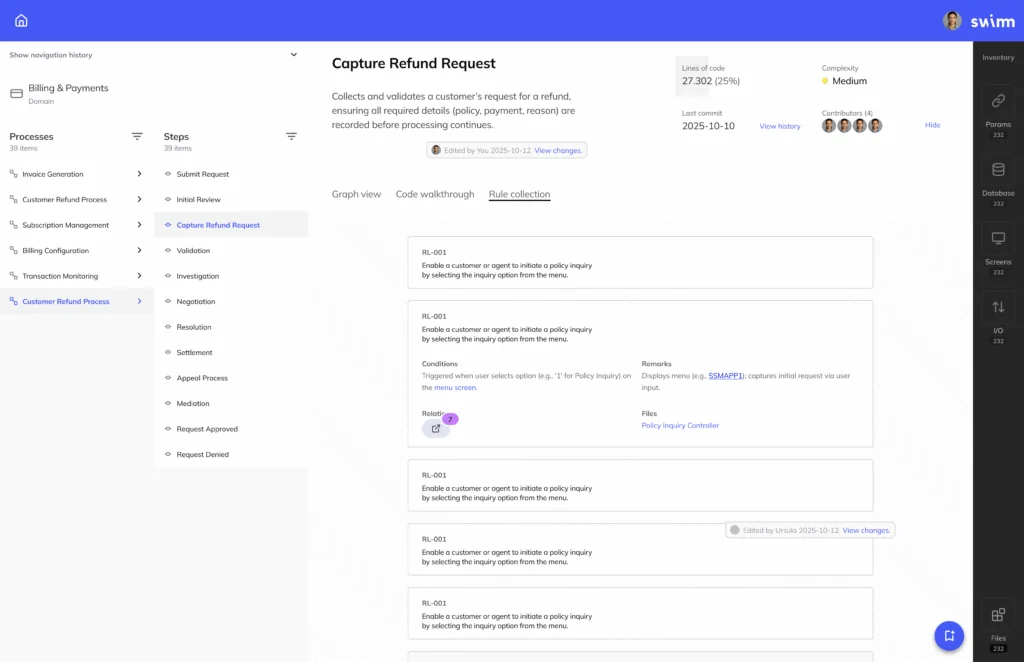
Swimm is an application understanding platform that produces accurate, code-derived understanding of how legacy applications behave. By combining deterministic static analysis with generative AI, Swimm translates legacy code into reliable, human-readable knowledge that enterprise teams can act on with confidence.
The platform is designed for highly secure enterprise environments, serving banks, insurers, and other regulated industries where accuracy and auditability are non-negotiable.
Key features:
- Business rule extraction: Uncovers and explains the business rules spread throughout applications, making embedded logic visible and reviewable
- Architectural overviews: Maps application architectures, breaking down programs, jobs, flows, and dependencies into clear visual structures
- Natural language translation: Converts cryptic program and variable names into descriptive, easy-to-understand terms for faster comprehension
- Customizable legacy language support: Handles complex and proprietary implementations of COBOL, CICS, and PL/I with specialized parsers and company-specific plug-ins
- Deterministic analysis: Static analysis prevents LLM hallucinations, ensuring accurate understanding across millions of lines of code
Best for: Enterprises modernizing complex mainframe and legacy core applications that need accurate, evidence-backed understanding of application behavior – from initial assessment through requirements engineering, forward engineering, and migration.
Source: Swimm
CAST

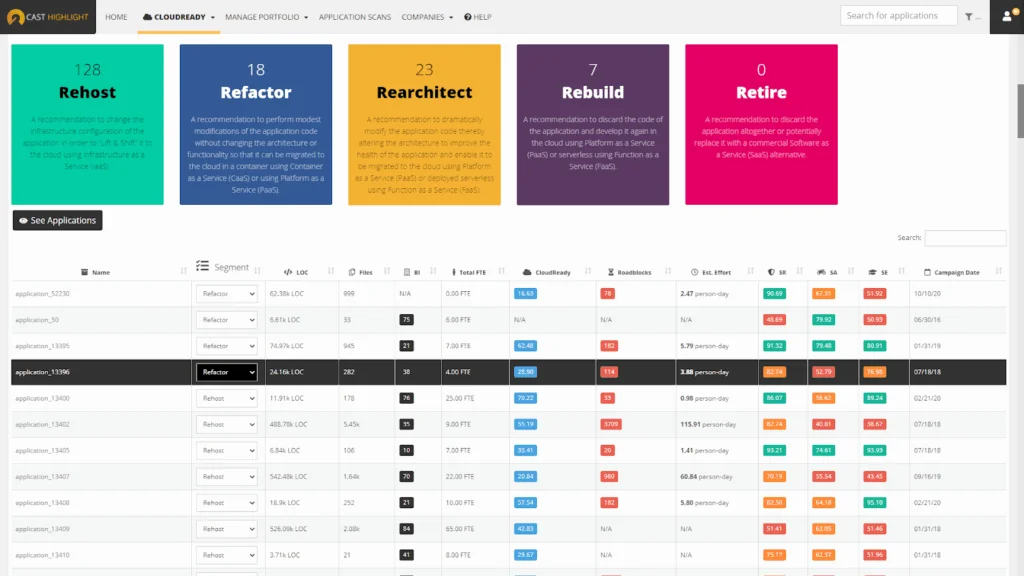
CAST provides software intelligence across two complementary products: CAST Highlight for portfolio-level governance and CAST Imaging for application-level architecture visualization. Together, they give executives and architects visibility into technical debt, cloud readiness, and modernization impact across entire application portfolios.
CAST’s analysis draws on a large empirical dataset covering 100 billion lines of analyzed code and 50,000 relationship heuristics across 150+ languages, frameworks, and databases.
Key features:
- Portfolio governance (CAST Highlight): Assesses technical debt, cloud maturity, legal exposures, and code inefficiencies across software portfolios to prioritize modernization investments
- Architecture visualization (CAST Imaging): Maps all stack elements and interactions, revealing dependencies, faulty constructions, and the impact of proposed changes
- AI context delivery: Provides full architectural context that AI agents can consume to operate with awareness of entire codebases
- Modernization path analysis: Identifies paths to modernize and simulates the impact of changes across components before execution begins
Best for: Organizations managing large application portfolios that need portfolio-level visibility into technical debt and cloud readiness, combined with detailed architecture mapping for modernization planning.
Source: CAST
Moderne

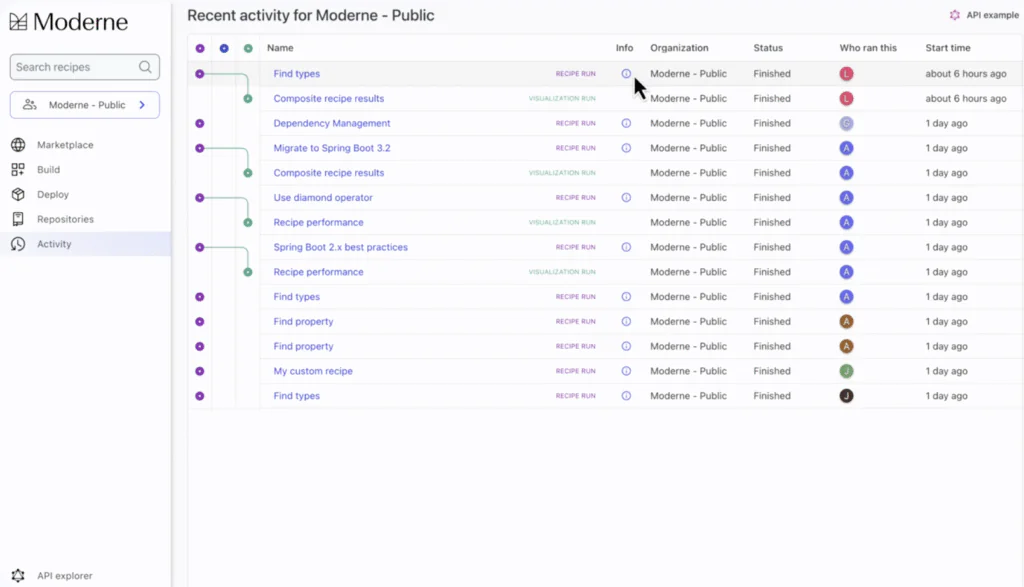
Moderne builds code intelligence and transformation tools powered by the OpenRewrite Lossless Semantic Tree (LST) – a code model that enables precise, semantic-level analysis and modification across large codebases. The platform is designed for organizations running coding agents at scale, providing the contextual knowledge and governance those agents need to operate accurately.
Key features:
- Lossless Semantic Tree (LST): Provides what Moderne describes as “the industry’s most comprehensive context model for code,” enabling code-aware analysis that understands structure, not just syntax
- Deterministic code transformations: Automates framework, language, and dependency upgrades across repositories with full traceability
- Organization-wide code search: High-performance discovery across large code estates, faster than traditional search approaches
- Multi-repository coordination: Executes synchronized changes across entire software portfolios with full traceability
- Security remediation at scale: Bulk vulnerability remediation using verified transformations across thousands of repositories
Best for: Engineering organizations managing large, distributed codebases that need automated, deterministic code transformations – including framework upgrades, dependency migrations, and security remediation – across hundreds or thousands of repositories.
Source: Moderne
Cloud and infrastructure migration
These platforms handle the movement of workloads from legacy environments to cloud infrastructure, providing assessment, planning, and execution capabilities for hybrid cloud and multi-cloud migrations.
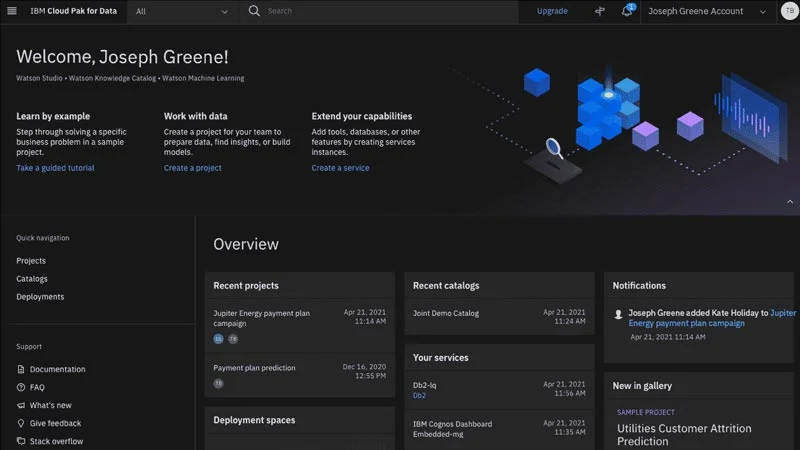
IBM Cloud Pak for Applications

IBM Cloud Pak for Applications is an AI-assisted modernization platform built on Red Hat OpenShift that transforms legacy systems into cloud-native applications. It enables organizations to modernize runtimes, migrate workloads, and adopt microservices architectures across hybrid cloud environments without locking into a single cloud provider.
The platform includes Mono2Micro for monolith decomposition and Transformation Advisor for assessment and migration planning.
Key features:
- Hyperscaler-independent hybrid cloud: Moves workloads across on-premises, public, and private cloud environments on a platform independent of any single hyperscaler
- AI-assisted monolith decomposition: Breaks down monolithic applications into smaller, manageable microservices using AI-driven analysis
- Side-by-side VM and container operation: Migrates workloads with minimal disruption by operating virtual machines and containers on a single platform during transition
- Automated security compliance: Ensures continuous security compliance through automated vulnerability assessment and identification
- Cloud-native development support: Supports microservices architectures with containerized workloads on Red Hat OpenShift
Best for: Enterprises executing hybrid cloud migrations that need a vendor-neutral platform for moving and modernizing workloads across on-premises and multi-cloud environments.
Source: IBM
AWS Transform
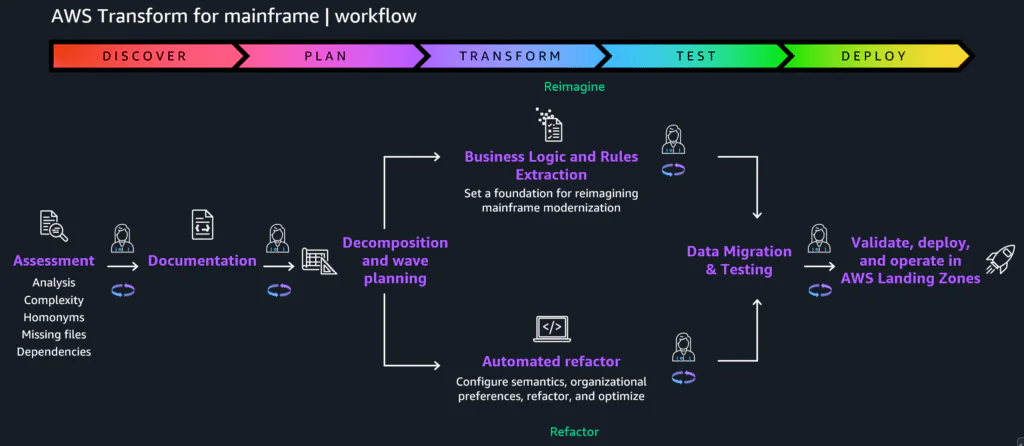
AWS Transform is an agentic AI service that automates enterprise modernization across Windows, mainframe, VMware, and custom code workloads. Built on 19 years of AWS migration and modernization experience, it uses specialized AI agents to handle assessments, code analysis, refactoring, dependency mapping, and transformation planning in parallel.
Key features:
- Agentic AI automation: Automates assessments, code analysis, refactoring, decomposition, dependency mapping, validation, and transformation planning through specialized AI agents
- Parallel execution at scale: Modernizes hundreds of applications simultaneously through parallel task execution
- Natural language collaboration: Provides a chat interface with shared workspaces for cross-functional team collaboration and real-time progress tracking
- Multi-workload coverage: Supports full-stack Windows modernization, mainframe transformation, VMware migration, and custom code transformations (Java, Node.js, Python)
Best for: Organizations modernizing large, heterogeneous application portfolios on AWS that need AI-driven automation to accelerate migration timelines and reduce manual effort across multiple workload types.
Source: AWS
Mainframe modernization
These tools specialize in modernizing mainframe environments – either by replatforming workloads to open systems and cloud infrastructure, or by extending existing mainframe systems with modern interfaces, APIs, and development workflows. Both approaches serve organizations running IBM Z, AS/400, or similar mainframe environments.
Rocket Software
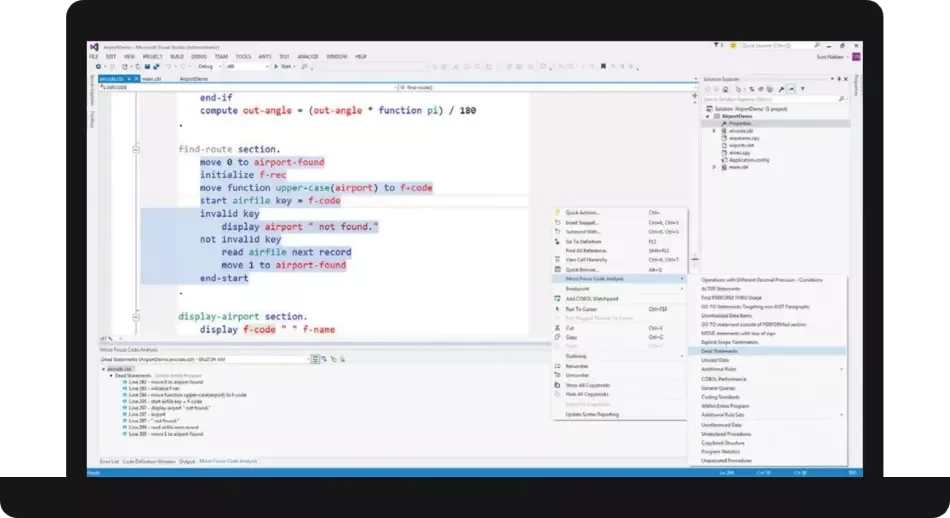
Rocket Software provides modernization tools that extend IBM i and IBM Z capabilities through an innovation layer, enabling organizations to add modern interfaces, DevOps workflows, and API access without replacing core systems. The company’s approach – which it describes as “modernization without disruption” – focuses on preserving existing mainframe investments while making those systems accessible to modern development teams.
Key features:
- No-code interface modernization (LegaSuite and Rocket API): Delivers modern, intuitive user experiences for legacy applications without requiring code changes to core systems
- Open development on z/OS (Open AppDev): Provides 1-click porting and gives developers access to preferred open-source tools while maintaining mainframe security and support
- IBM i DevOps and ALM (Rocket Aldon): Enables developers to work with modern tools and environments while maintaining process management and compliance reporting
- API enablement: Extends legacy application functionality through APIs for process automation and integration with modern platforms
Best for: Organizations running IBM i or IBM Z environments that want to modernize interfaces, development workflows, and integrations without migrating off the mainframe.
Source: Rocket Software
TmaxSoft OpenFrame
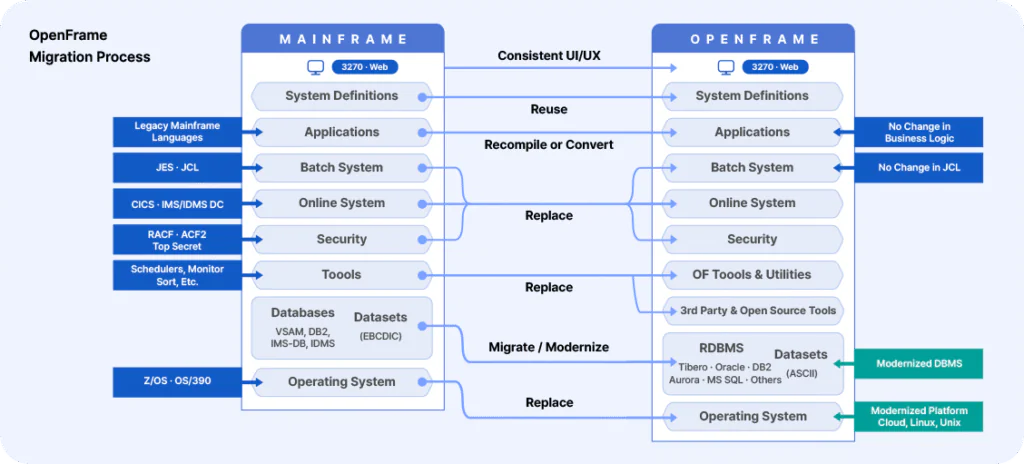
OpenFrame from TmaxSoft is a mainframe replatforming solution that migrates legacy applications and data to open systems – Linux, Unix, Docker containers, or public cloud – without altering existing business logic. It replaces the mainframe runtime environment while preserving the application code, data, and end-user experience.
Key features:
- 3-tier architecture for open systems: Provides a future-oriented architecture with performance, stability, and scalability beyond 100K MIPS on open platforms
- Automated conversion without source code changes: Advanced compiler technology automatically converts UI logic, application logic, and data without modifying the mainframe source code
- Broad language support: Supports COBOL, PL/I, and an Assembler compiler for comprehensive mainframe application coverage
- Full modernization software package: Includes tools for batch processing, data management, middleware, and operations management, along with alternatives for mainframe utilities like Sort, Report, and Scheduler
Best for: Enterprises running mainframe workloads that want to replatform to open systems or cloud infrastructure while preserving existing COBOL, PL/I, or Assembler applications without code modification.
Source: TmaxSoft
Narrowing from seven tools to your shortlist
The seven platforms above span three distinct modernization patterns. Most organizations will not need all three categories. Use this framework to narrow to 2-3 tools for deeper evaluation:
If your primary challenge is understanding what legacy applications do – because business logic is embedded in millions of lines of undocumented code, or because institutional knowledge has been lost over time – start with the application understanding and code intelligence category. Establishing accurate understanding of business rules, dependencies, and application behavior before committing to transformation reduces execution risk across the rest of the program.
If your primary challenge is moving workloads to cloud infrastructure, and you already have a clear understanding of your applications, focus on the cloud and infrastructure migration category. The key differentiator here is cloud provider independence: IBM Cloud Pak operates across any hyperscaler, while AWS Transform is purpose-built for the AWS ecosystem.
If your primary challenge is running mainframe workloads more cost-effectively, the mainframe modernization category offers two distinct approaches. Rocket Software modernizes in place, adding modern interfaces and workflows to existing IBM i/Z systems. TmaxSoft OpenFrame replatforms entirely, moving workloads to open systems while preserving the application code.
Most large modernization programs combine tools across categories. An enterprise migrating a complex COBOL mainframe to cloud might use an application understanding tool to extract and document business rules first, then a replatforming tool to execute the infrastructure migration. Treating these as sequential phases – understand, then transform – reduces the risk of each phase.
FAQ
What is the difference between application modernization and migration?
Migration moves an application from one environment to another – for example, from an on-premises data center to a cloud platform – typically without significant changes to the application itself. Modernization is broader: it includes migration but also encompasses refactoring code, decomposing monoliths into microservices, replacing legacy frameworks, and re-architecting systems for cloud-native patterns. Migration is one approach within the larger modernization spectrum.
How long does application modernization typically take?
Timelines vary significantly based on the complexity of the application, the modernization approach, and the target architecture. A straightforward replatforming of a well-documented application might take weeks. Modernizing a complex mainframe system with millions of lines of undocumented COBOL code – where the first step is understanding what the application actually does – can take months to years. The time spent establishing accurate understanding of the existing system before beginning transformation is often the most consequential investment in the entire program.
Can AI fully automate application modernization?
AI accelerates specific phases of modernization – code analysis, dependency mapping, transformation planning, and even code generation – but does not eliminate the need for human judgment. Complex modernization decisions involve business context, risk tolerance, and organizational constraints that require human expertise. The most effective approach in 2026 combines AI automation for analysis and execution at scale with human review for validation, business rule interpretation, and strategic decision-making.
What role does application understanding play in modernization?
Application understanding – knowing what an application actually does, including its business rules, data flows, dependencies, and embedded decision logic – is the foundation of any modernization program. Without accurate understanding, teams risk migrating broken logic, missing critical dependencies, or introducing defects during transformation. Many modernization programs stall not because the migration tooling fails, but because the team lacks a clear, verified understanding of the system they are changing. Establishing that understanding first reduces execution risk across the entire program.


