Enterprise application portfolios contain decades of accumulated complexity. Business logic embedded in aging systems, dependencies that span thousands of files, and architectures built before cloud computing existed – these realities define most modernization programs today. Organizations that attempt to modernize without first establishing a clear picture of what they have consistently encounter scope expansion, missed dependencies, and timeline overruns.
Application modernization solutions address this challenge, but they don’t all address it the same way. Some focus on cloud migration and infrastructure transformation. Others analyze existing codebases to produce the understanding that migration depends on. Still others deliver end-to-end services that combine assessment, planning, and execution under one engagement.
This guide covers five leading application modernization solutions in 2026, grouped by approach, with selection criteria to help match a solution to your situation.
What application modernization involves
Application modernization is the process of updating existing software systems to run on modern infrastructure, follow modern architectural patterns, and support modern delivery practices. The scope varies considerably by organization and system type.
Common modernization activities include:
- Migrating workloads from on-premises data centers to public, private, or hybrid cloud environments
- Converting monolithic applications into loosely coupled services or microservices
- Containerizing applications to improve portability and deployment consistency
- Replacing or extending mainframe applications with cloud-native alternatives
- Establishing CI/CD pipelines and DevOps practices to support faster delivery
- Analyzing existing codebases to understand behavior, dependencies, and business rules before making changes
Organizations pursue these changes to reduce infrastructure and maintenance costs, increase deployment frequency, improve system resilience, and reduce the operational risk that comes from running systems that fewer people understand. Modernization is not a one-time event – it’s a program that runs over months or years, with sequencing decisions that depend heavily on how well teams understand what they’re working with.
How to evaluate application modernization solutions
The right solution depends on what problem you’re actually solving. Before evaluating specific tools or services, clarify:
What is the biggest bottleneck? If your team cannot clearly describe how existing applications behave – what business rules they implement, how components depend on each other, which processes flow across which systems – application understanding is the bottleneck. No migration plan survives contact with poorly understood source systems. In this case, assessment and understanding platforms are the higher priority.
If the architecture is reasonably well-documented and the challenge is execution – moving workloads, containerizing applications, establishing cloud-native infrastructure – then migration platforms or full-service providers may be the right entry point.
Platform or services? Application modernization solutions fall into two broad delivery models. Platforms are software tools your team operates, with the vendor providing the technology. Service providers deliver outcomes through a consulting engagement, with the vendor supplying both expertise and tools. Many organizations need both, often from different vendors.
What systems are in scope? Solutions that excel at mainframe modernization – COBOL, PL/I, JCL, CICS – typically have different strengths than tools designed for Java, .NET, or containerized web applications. Confirm that a solution actually handles the specific languages, databases, and integration patterns in your portfolio.
What is your cloud strategy? Organizations with committed cloud provider relationships may prefer solutions that integrate tightly with their chosen platform. Those operating hybrid or multicloud environments need solutions with broader compatibility.
What is the risk tolerance? Modernization programs for regulated industries – banking, insurance, healthcare – carry different compliance requirements and risk profiles than programs in less regulated sectors. Solutions designed for these environments prioritize accuracy and traceability over speed.
Application modernization solutions
The five solutions below are grouped into three categories based on their primary approach. Within each category, solutions are ordered by their typical entry point in the modernization lifecycle.
Application understanding and assessment platforms
These platforms analyze existing codebases to produce structured, reliable knowledge about how applications behave – the business rules they implement, the dependencies they carry, and the architectural patterns they follow. This understanding is the foundation that accurate modernization planning depends on.
1. Swimm
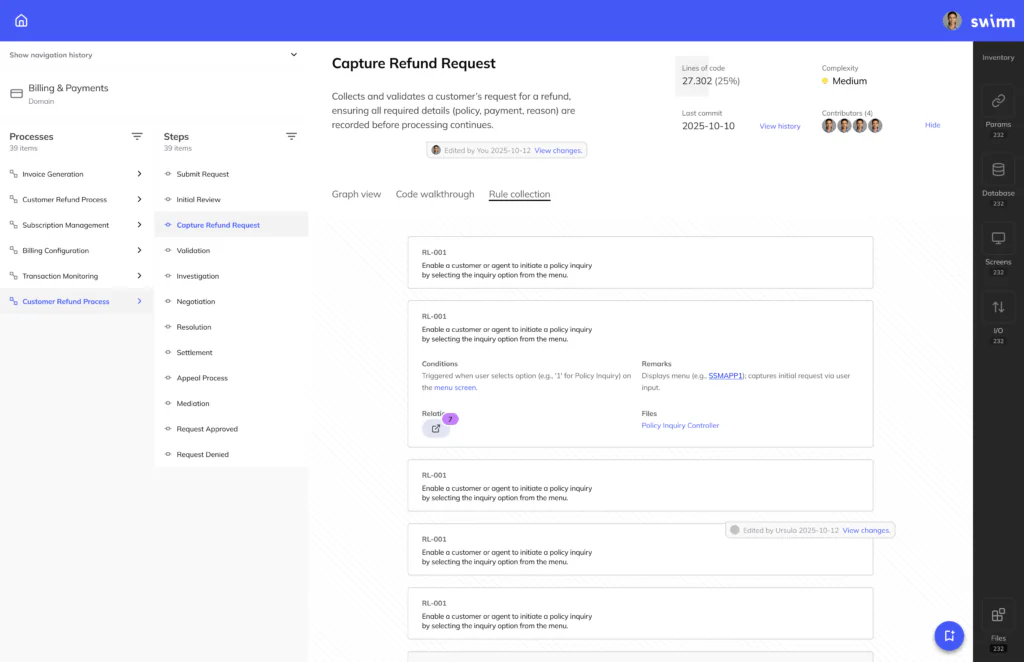
Swimm’s Application Understanding Platform addresses one of the most common failure modes in modernization programs: committing to a migration scope before accurately understanding what exists. By combining deterministic static analysis with generative AI, Swimm produces reliable, human-readable understanding of legacy applications – including the business logic, architectural structure, and data flows that teams need to plan and execute change with confidence.
The platform is designed for highly secure enterprise environments and handles COBOL, CICS, and PL/I with specialized parsers and company-specific customization.
Key features:
- Business rule extraction: Uncovers and explains the business logic embedded in legacy codebases, making implicit rules explicit and accessible to business, architecture, and engineering teams
- Architectural overviews: Maps applications into clear visual structures – programs, jobs, flows, dependencies – so teams can understand scope and relationships before committing to change
- Natural language translation: Converts cryptic program and variable names into descriptive, readable terms, reducing the time required to understand unfamiliar code
- Customizable language support: Handles complex and proprietary COBOL, CICS, and PL/I implementations with specialized parsers and company-specific plug-ins
- Hallucination prevention: Deterministic static analysis derived directly from source code prevents the inaccuracies that LLM-only approaches produce at scale
Best for: Enterprise teams modernizing mainframe and legacy core systems where accurate application understanding is the prerequisite to migration planning – particularly banks, insurers, and other regulated organizations where the cost of acting on incomplete information is high.
Source: Swimm
2. CAST Software

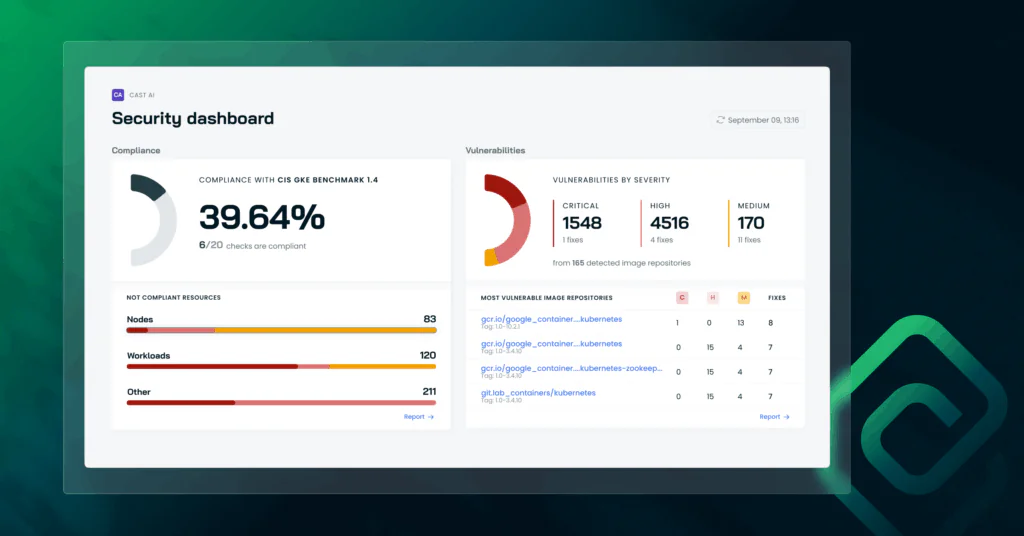
CAST Software offers a portfolio of software intelligence products that analyze codebases to map internal architecture and dependencies. CAST Imaging, the primary modernization tool, reverse-engineers application internals into a living knowledge base that architects and engineers can explore, annotate, and use for migration planning.
CAST also offers CAST Highlight for portfolio-level governance, providing visibility into technical debt, cloud readiness, and compliance exposure across entire application portfolios.
Key features:
- Full stack dependency mapping: Maps all elements in the stack and all interactions, including cross-application dependencies and database relationships
- Modernization pathway identification: Surfaces paths to modernize and assesses the impact of planned changes before they’re made
- Structural quality analysis: Identifies faulty constructions, technical debt, and cloud readiness gaps with specific remediation guidance
- AI context provision: Produces structured architectural context to feed AI tools and agents, enabling more accurate AI-driven forward engineering
- Portfolio governance (CAST Highlight): Tracks technical debt, cloud maturity, legal exposures, and code inefficiencies across the full application portfolio
Best for: Architecture and engineering teams that need detailed visibility into complex multi-technology systems before designing a modernization roadmap, particularly in organizations running applications across 150+ languages, frameworks, and databases.
Source: CAST Software
Full-service modernization providers
These vendors deliver modernization outcomes through consulting engagements, combining their own tools, methodologies, and domain expertise. They are appropriate when organizations need not just technology but execution capacity, program governance, and deep industry experience.
3. IBM Application Modernization
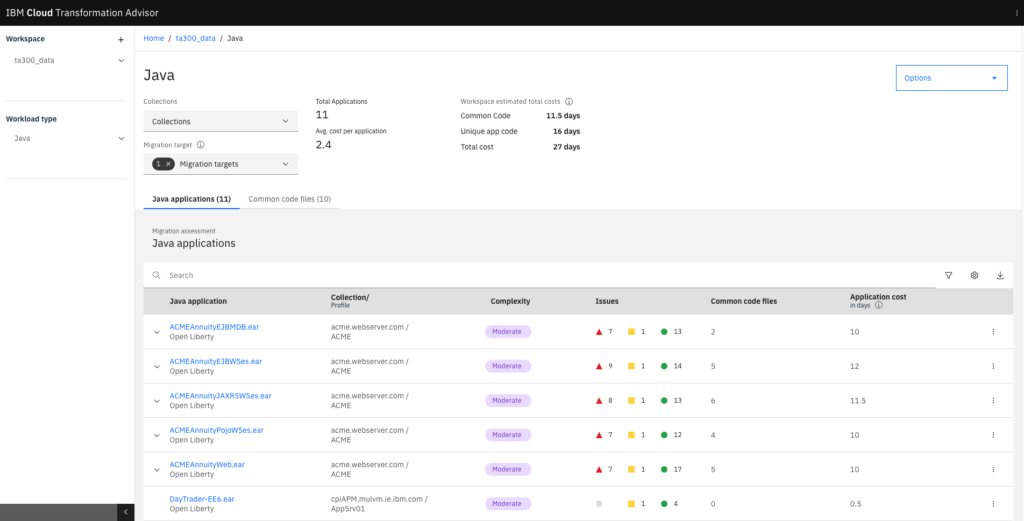
IBM provides application modernization services through IBM Consulting, applying hybrid cloud strategy and generative AI to help organizations move legacy applications to modern environments. Services are delivered via the IBM Consulting Advantage for Cloud Transformation platform, with established methodologies and partnerships across major cloud providers.
IBM’s approach is data-driven: assessments categorize the application portfolio and recommend a strategy per application – rehosting, replatforming, refactoring, rewriting, or retiring – based on business value and technical complexity.
Key features:
- IBM Consulting Advantage for Cloud Transformation: Provides the skills, methods, and tools to determine the right modernization strategy per application and execute it at scale
- Generative AI for code migration: Applies generative AI to code generation and containerization, enabling developers across experience levels to migrate and modernize legacy code with consistency and speed
- Full modernization strategy coverage: Supports rehosting, replatforming, refactoring, rewriting, and retiring applications based on portfolio assessment and business goals
- Mainframe modernization services: Reduces risk in hybrid multi-cloud environments for mainframe workloads, from initial discovery through deployment, using AI-powered tools and proven assets
- Multi-cloud strategic partnerships: Works with AWS, Microsoft Azure, Google Cloud, and IBM Cloud using reusable blueprints and methodologies across design, migration, and operations
Best for: Large enterprises that need both strategy and execution capacity for complex, multi-system modernization programs – particularly those with significant mainframe investments or multi-cloud commitments requiring a vendor-neutral delivery partner.
Source: IBM Consulting
4. Rocket Software
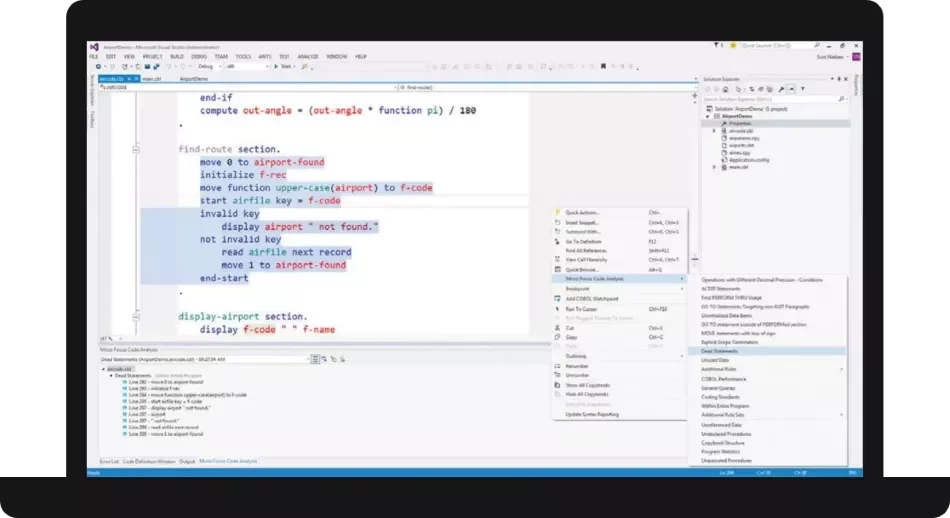
Rocket Software positions its modernization portfolio around a single principle: modernization without disruption. The company focuses on organizations with mission-critical systems that cannot tolerate downtime or instability during transformation, providing a path through on-premises modernization, hybrid cloud integration, or replatforming based on where each organization is in their journey.
Recent 2026 product releases, including Rocket EVA and Rocket ContentEdge, extend the portfolio into AI-assisted interaction and governed data modernization.
Key features:
- Modernization without disruption: Supports critical applications through on-prem modernization, hybrid cloud integration, or replatforming without disrupting existing operations
- Automated testing and CI/CD: Integrates automated testing and continuous integration and deployment pipelines to accelerate delivery while maintaining quality
- GenAI-assisted development: Applies generative AI to accelerate developer onboarding and code modernization, reducing the learning curve for legacy systems
- Rocket EVA (enterprise virtual assistant): Enables natural-language interaction with core systems to improve operational efficiency without requiring system replacement
- Governed data modernization (Rocket ContentEdge): Provides safe, governed, in-place access to protected unstructured data, enabling GenAI and intelligent automation across cloud, on-premises, and mainframe environments
Best for: Organizations running IBM mainframe, IBM i, or other legacy infrastructure that need to modernize incrementally while keeping critical systems online – particularly those in industries where operational continuity is non-negotiable.
Source: Rocket Software
Cloud-native modernization platforms
These platforms provide the infrastructure, tooling, and frameworks to modernize toward cloud-native architectures. They are most effective when the organization has already committed to a cloud provider and needs structured guidance on how to execute the transition at scale.
5. Google Cloud application modernization (CAMP)

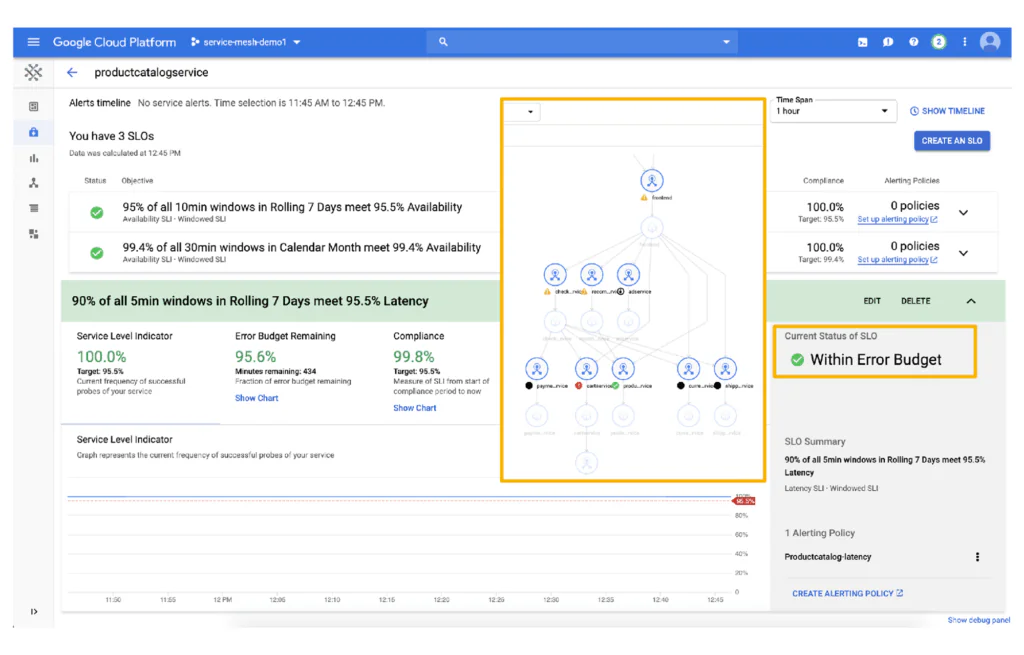
Google Cloud’s Cloud Application Modernization Program (CAMP) is an end-to-end framework that guides organizations through modernization by assessing their current state and identifying the most effective path forward. CAMP combines data-driven assessment with concrete recommendations and Google’s managed platform for building, operating, and securing modernized applications.
The framework draws on six years of DevOps Research and Assessment (DORA) research to connect modernization practices with measurable business and performance outcomes.
Key features:
- CAMP framework: An end-to-end modernization framework that assesses current state and identifies tailored paths forward, covering container migration, application modernization, and cloud-native development
- DORA-backed practices: Framework recommendations are grounded in six years of DORA research into the engineering and delivery practices that drive high performance
- Data-driven assessment: Provides tailored modernization advice through portfolio assessment, covering where to start and what approach fits each application type
- Mainframe migration tooling: Includes automated tools and prescriptive guidance for moving mainframe applications to the cloud
- Software supply chain and CI/CD: Covers innerloop developer productivity, CI/CD integration, and software supply chain security best practices
- Managed platform for cloud-native development: Provides an extensible platform covering code writing, deployment, operation, and security, with integrated DevOps tooling
Best for: Organizations with an existing Google Cloud commitment that need a structured, research-backed framework for modernizing mixed portfolios – including traditional Java/.NET applications, containerized workloads, and mainframe migrations to GCP.
Source: Google Cloud CAMP
How to choose an application modernization solution
The categories above reflect genuinely different entry points in the modernization lifecycle. The table below summarizes the key dimensions for comparison:
| Solution | Category | Primary strength | Delivery model | Best entry point |
|---|---|---|---|---|
| Swimm | Understanding platform | Business rule extraction, legacy code analysis | Software platform | Before migration planning |
| CAST Software | Understanding platform | Architecture mapping, portfolio intelligence | Software platform | Assessment and architecture review |
| IBM Application Modernization | Full-service provider | End-to-end program delivery, mainframe | Consulting engagement | Program planning and execution |
| Rocket Software | Full-service provider | Disruption-free modernization, IBM systems | Platform + services | Incremental modernization |
| Google Cloud CAMP | Cloud platform | Cloud-native transformation, DORA practices | Framework + managed platform | Cloud migration execution |
A few practical decision rules:
Start with understanding if your team cannot accurately describe existing application behavior. Attempting to plan migration scope around incomplete knowledge of what exists is a reliable source of late-stage rework and scope expansion. Understanding platforms like Swimm or CAST Imaging reduce this risk before it compounds.
Choose full-service providers when execution capacity is the constraint. Many organizations have enough architectural clarity to plan but lack the delivery capacity or specialized skills to execute at pace. IBM and Rocket Software bring both methodology and delivery resources.
Choose cloud platforms when the destination is clear. If Google Cloud is the target environment and the challenge is figuring out how to get there systematically, CAMP provides the assessment framework and platform services to execute at scale.
Match the solution to the application type. Solutions optimized for mainframe modernization (Swimm, Rocket Software, IBM’s mainframe services) have different technical capabilities than solutions designed for Java and .NET application modernization. Confirm language and technology compatibility before selecting.
Frequently asked questions
What is the difference between application modernization tools and services? Tools are software platforms your team operates to analyze codebases, plan migrations, or build cloud-native applications. Services are consulting engagements where a vendor provides expertise and delivery capacity. Many modernization programs need both – a platform for analysis and understanding, and services for execution. They’re not mutually exclusive, and different vendors can provide each.
Should we start with application assessment or jump to migration? Assessment first is the standard recommendation, and for good reason. Migration programs that begin without a clear understanding of application behavior, dependencies, and business rules consistently encounter scope changes, missed integrations, and defects that surface late in testing. The cost of a thorough assessment is typically a fraction of the cost of rework caused by acting on incomplete understanding.
What types of applications benefit most from modernization? Applications that carry the most risk for modernization are typically those with the highest business criticality and the least documented behavior. Core banking systems, insurance claims processing engines, and order management platforms often fit this profile. These are also the applications where accurate understanding matters most before any change is made.
How does application understanding differ from code documentation? Code documentation describes what code does at a file or function level. Application understanding describes how the full application behaves – what business rules it implements, how components interact across the system, how data flows through processes, and what business logic is embedded in code. Application understanding is what teams need to make change decisions with confidence; line-level documentation is rarely sufficient for that purpose.
Summary
Application modernization solutions address different challenges depending on where an organization is in its program. Understanding platforms are most valuable when the knowledge gap is the primary obstacle. Full-service providers are most valuable when execution capacity and delivery governance are needed. Cloud platforms are most valuable when the migration destination is established and the focus is on systematic execution.
In every case, accurate understanding of existing application behavior reduces execution risk. Whether that understanding comes from a dedicated platform or an embedded assessment within a larger service engagement, establishing it before committing to scope is what separates programs that deliver on their timelines from those that don’t.
To see how application modernization fits into broader modernization strategy, explore our guide to application modernization tools, the best legacy code modernization tools, and best mainframe modernization services for related coverage.
Swimm is an Application Understanding Platform that helps enterprise teams establish accurate, code-derived understanding of legacy applications before and during modernization. To see how Swimm supports your program, request a demo.


